
How AutoTradix works
A simple way to put your cash to work — without becoming a day trader.
AutoTradix is built for one type of person: someone who already keeps money in a savings account, a money-market fund, or short-term treasuries, and who would like to try earning a little more on a portion of that cash — without watching charts all day.
The idea behind the product is called grid trading. This page explains what it is, how it tries to make money, and — just as importantly — when it can hurt you.
Who this is for
Money-market funds and treasury bonds typically pay a yield set by interest rates. That yield is steady and low-stress, but it caps your upside. The trade-off AutoTradix offers is different:
Money market / treasuries
- • Predictable, low yield set by interest rates
- • Very low risk of principal loss
- • Zero work, zero engagement
- • Upside is capped no matter what markets do
A grid on a stable name
- • Tries to earn small, repeated gains as price wiggles
- • Real market risk — you can lose money
- • Set it once, let it run; check in occasionally
- • Upside is uncapped, but conditions matter
AutoTradix is not a replacement for a savings account or an emergency fund. It is a way to use a slice of your cash — money you can afford to expose to market risk — to try to do better than the safe alternatives over time. There is no guarantee that it will.
Grid trading in 30 seconds
Most stocks don't move in a straight line. They wiggle. They go up a little, down a little, up a little more, then back down — for weeks or months at a time before any real trend appears.
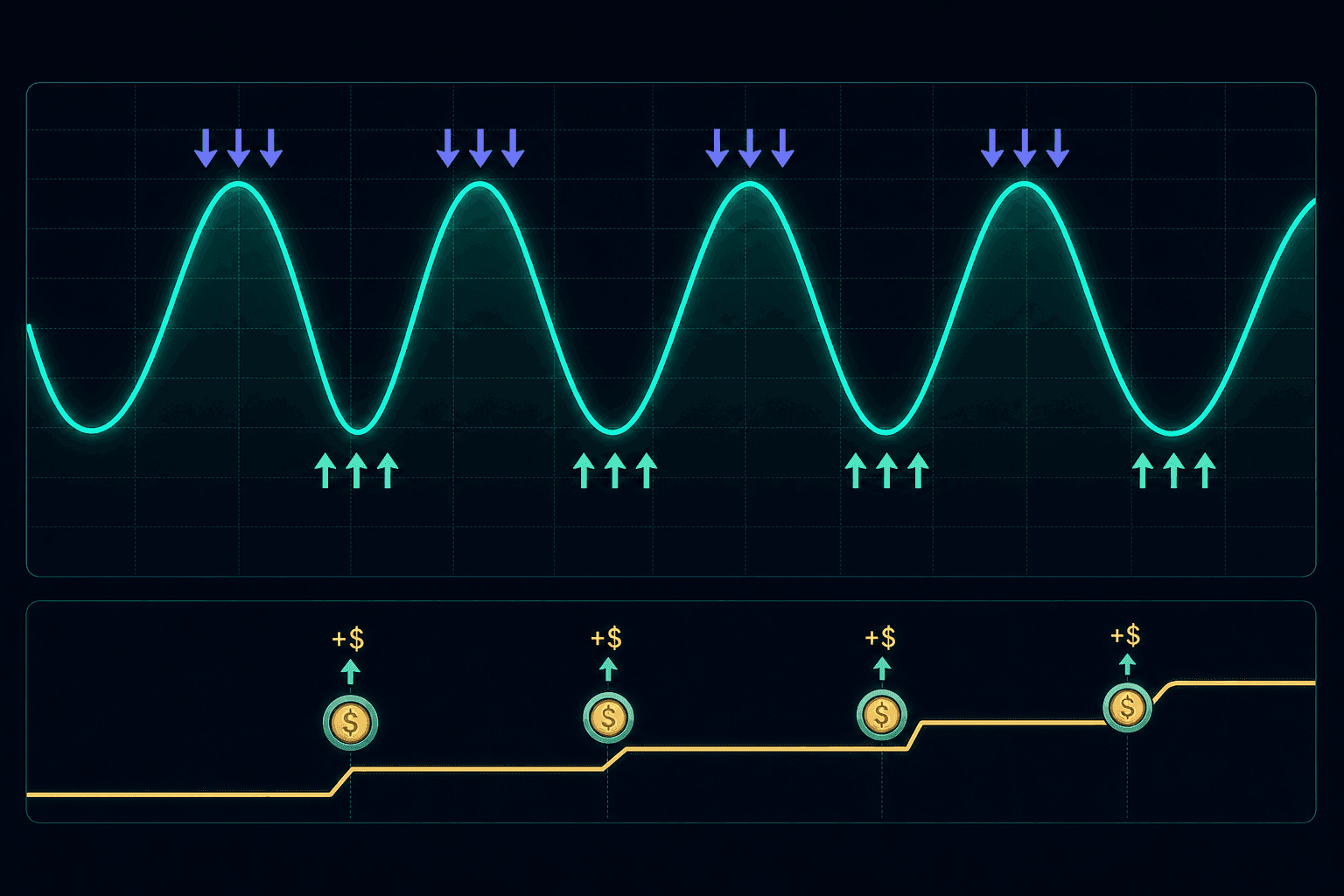
A grid is a stack of buy orders below the current price and sell orders above it, all spaced evenly apart. As the stock wiggles inside that band:
- When price drops to one of your levels, AutoTradix buys a small amount for you.
- When price rises to a level above where it bought, AutoTradix sells it for a small profit.
Each round trip is small. The point is that they can happen many times during the year — not from a big prediction being right, but from normal day-to-day movement.
Buy low, sell high — at every level
Top: each round trip across your grid books a small realized gain. Bottom: any dividends the stock pays accumulate on the side, independent of the grid.
A worked example
Suppose a stock you like is trading at $100, and you think it is likely to bounce between $95 and $105 for a while. You set:
- • Range: $95 to $105
- • Spacing: $2 per level
- • Size per level: 10 shares
Buy orders sit at $95, $97, $99. Sell orders sit at $101, $103, $105.
1. Price dips first
Price drifts from $100 down to $97. Your $99 buy fills (10 shares). Then your $97 buy fills (10 more). You now hold 20 shares at an average cost of $98. No profit yet — you have only built inventory at lower prices.
2. Price bounces back
Price climbs back to $103. Your $101 sell triggers, closing the shares bought at $99 → $2 × 10 = $20. Your $103 sell triggers, closing the shares bought at $97 → $6 × 10 = $60. Total locked in for this cycle: $80.
3. The cycle can repeat
If price dips again, your buy orders refill. If it climbs again, your sell orders fire. The same $10 range can produce many of these small cycles per year — without you predicting where price is “really” going.
This example is for illustration only. Actual fills, fees, slippage, taxes, and dividends are not modeled. Results depend on conditions outside your control and are not guaranteed.
Where does the money actually come from?
Grid trading does not predict direction. It is not magic, and it is not an arbitrage. It tries to make money from one thing only: real, two-sided price movement.
Every time price moves down to one of your buy levels and then back up to one of your sell levels, you capture the difference between those two levels (minus fees) as a small realized gain. If the stock you chose pays dividends, you also keep those dividends on whatever shares you happen to be holding at the time of payment.
Compared to a money-market fund or a treasury bond, the grid is trying to add a second source of return on top of the underlying instrument: the volatility itself. That extra return is not promised, and in calm or strongly trending periods it can be near zero or negative.
Where this can hurt you
Read this section even if you skim everything else.
Strong, sustained downtrends
If price keeps falling and never recovers, the grid keeps buying on the way down and ends up holding a losing position. This is the single biggest thing to understand.
Strong breakouts to the upside
If price rockets above your ceiling, the grid stops trading and you miss the rest of the move — you still own what you bought, but the grid itself goes quiet.
Gaps and overnight news
Earnings, dividends, or news can move price past several grid levels in one print. Fills can be different from what you expected.
Fees, taxes, and slippage
Lots of small trades mean lots of small frictions. Commissions, bid/ask spread, and short-term capital gains tax all eat into the result. Always model with your real broker costs.
Bottom line: grid trading is not a substitute for a savings account. It is a way to try to earn more on capital you can afford to put at risk, on a stock you would already be comfortable owning if the strategy went quiet.
What you set up, and what AutoTradix does
You decide
- Which stock or ETF to trade
- The price band (floor and ceiling)
- The spacing between levels
- How much to risk per level
- When to pause or stop
AutoTradix does
- Places the buy and sell orders at your broker
- Watches for fills during regular market hours
- Re-arms the next level after each trade
- Tracks realized and unrealized P&L
- Lets you pause everything in one click
Step 1
You pick a stock you already trust
A liquid, well-known ETF or stock you would be okay holding for months — for example a broad index ETF or a stable dividend name. AutoTradix never recommends symbols; the choice is yours.
Step 2
You set a price band
A floor and a ceiling that you think it is likely to bounce between for a while. The grid only works inside that band — outside of it, nothing happens.
Step 3
You set the spacing
How much price has to move before AutoTradix places the next buy or sell. Tighter spacing = more frequent, smaller trades. Wider spacing = fewer, bigger ones.
Step 4
The grid runs while you sleep
AutoTradix sends buy orders below the current price and sell orders above it, all via your own broker. Each time the price wiggles up and down inside your band, a small profit is locked in.
Ready to set up your first grid?
Connect your brokerage, pick one stock, set one band. You can stop the whole thing in one click at any time.
AutoTradix is a financial technology platform, not a financial advisor. Trading involves risk of loss. Past performance does not predict future results. Read the full legal disclaimer →